

The challenge: a significant mismatch between data center timelines and grid reinforcement lead times
■ The fundamental challenge facing large-scale data center grid connections is the significant mismatch between the two- to three-year timeline typically required for a data center to become operational and the three to five years—or, in some cases, more than ten years—required for grid reinforcement.
Bridging this gap is therefore critical to enabling the rapid development of large-scale data centers.
Two sources of “latent” grid capacity
■ One promising way to address this challenge is to identify and make effective use of what could be described as two sources of “latent grid capacity” embedded in the transmission and distribution network.
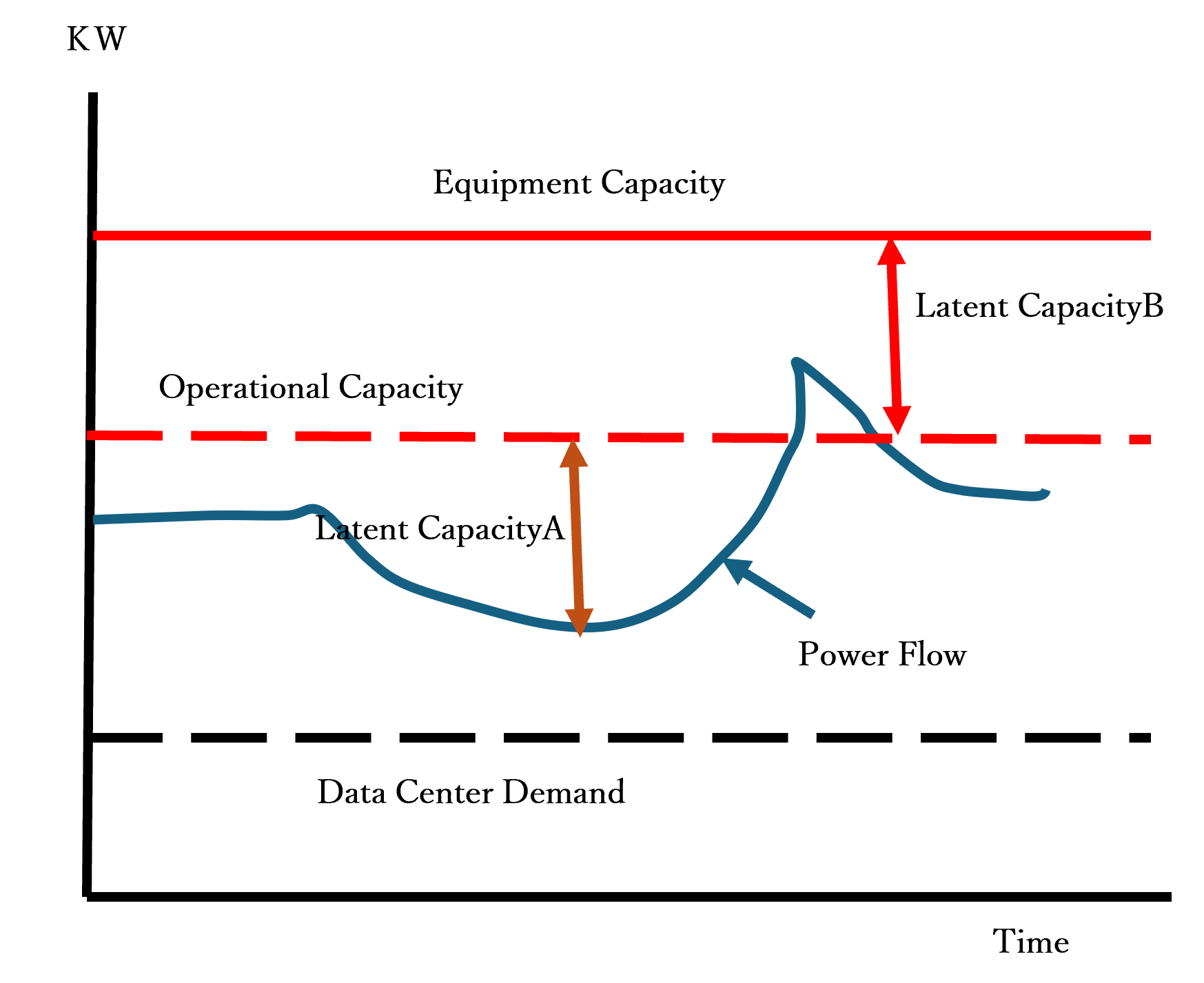
As illustrated in the figure below, transmission lines and substations have both an equipment capacity and an operational capacity (overload limit). In normal operation, utilities manage power flows so that they remain within the applicable operational capacity.
Latent Capacity A: Making use of unused operational capacity
■ When a data center is connected to the grid, if forward power flow—the flow of electricity toward the demand side—exceeds the operational capacity even for a relatively short period during the year, the utility may determine that there is insufficient available capacity and require grid reinforcement.
This can occur, for example, when the green line in the figure below slightly exceeds the red dotted line.
Utilities generally make such determinations conservatively, based on the most severe operating conditions that could occur.
■ However, a closer look at the figure reveals that, except during the periods when the green line exceeds the red dotted line, forward power flow remains below the operational capacity.
This unused margin represents the first source of “latent grid capacity”—what we refer to here as Latent Capacity A.
This capacity can be particularly significant in areas with a large amount of solar generation. During daylight hours, solar power flows in the reverse direction toward the grid, creating additional headroom for forward power flows.
In other words, if the data center can temporarily reduce its electricity demand during the periods when the green line would otherwise exceed the red dotted line, sufficient capacity may effectively be available throughout the year, potentially eliminating the need for costly grid reinforcement.
This approach is known in Japan as demand-side non-firm connection, in which demand is curtailed during periods of grid congestion. Internationally, a similar concept is often referred to as a “flexible connection.”
Latent Capacity B: Utilizing the margin reserved for N-1 contingencies
■ There is another important source of latent capacity: the substantial gap between operational capacity and equipment capacity.
Electric utilities generally operate their networks based on the N-1 reliability criterion. In simple terms, even if one transmission line or transformer fails, the remaining facilities must be capable of maintaining supply and preventing a widespread outage.
As a result, utilities do not normally operate transmission lines and transformers at their full equipment capacity. Instead, they maintain sufficient operating margin to accommodate an N-1 contingency.
This reserved margin represents the second source of “latent grid capacity”—what we refer to here as Latent Capacity B.
In theory, making use of this capacity could enable a large-scale data center to connect to the grid without waiting for conventional grid reinforcement.
However, this approach requires the data center to be capable of instantaneously reducing its load in the event of a grid fault or other N-1 contingency. This concept is generally referred to as N-1 load shedding.
Practical challenges
■ Both demand-side non-firm connection and N-1 load shedding can potentially enable large-scale data centers to connect to the grid without major reinforcement work. However, each approach presents practical challenges.
With demand-side non-firm connection, the data center’s load must be curtailed in real time based on continuously changing power flows across the network. This can make grid operation significantly more complex for the utility and may require sophisticated control and communication systems. In practice, developing and implementing the necessary systems can take several years.
With N-1 load shedding, the data center may be required to disconnect or substantially reduce its load for an extended period following a fault or during planned maintenance outages. The data center operator therefore needs to have robust measures in place to maintain business continuity during such periods.
Start with Latent Capacity A
■ While demand-side non-firm connection and N-1 load shedding can provide powerful tools for accelerating grid connections, the ideal solution is to identify locations where sufficient Latent Capacity A already exists.
The first step, therefore, should be to conduct a detailed assessment of available capacity at the level of individual substations and transmission lines, identify locations with sufficient headroom, and then engage with the relevant utility to determine the feasibility of connecting the data center.
How we can help
■ Beyond Next Energy provides a range of services to support the grid connection of large-scale data centers, including the identification and assessment of available grid capacity and support in discussions with utilities.
Please feel free to contact us to discuss how we can help accelerate your data center grid connection.

Spent many years at Tokyo Electric Power Company (TEPCO) in corporate planning, new business development and investment. Held positions including Deputy General Manager of Corporate Planning (2013), General Manager of the International Department (2015) and Secretary General of the New Growth Task Force (2016). Served as Director of Eurus Energy Holdings Corporation, a leading renewable energy company, and as Representative Director of TRENDE Inc., a renewable energy start-up. After leaving TEPCO, served as Managing Director of Environment Energy Investment Co., Ltd., a venture capital firm, and as Representative Director and President of Clean Energy Connect Inc. Currently also serves as Representative Director and Chairman of Japan Electricity Procurement Solution.








コメント